“By 2030, AI could contribute up to $15.7 trillion to the global economy.” — PwC Global AI Study. If that number made your jaw drop, you’re not alone!
I still remember the first time I asked an AI chatbot a question and got a better answer than I’d find on most websites. It felt like magic. But it isn’t magic — it’s math, data, and some incredibly clever engineering. And the best part? You don’t need a computer science degree to understand it.
In this guide, we’re going to break down exactly what artificial intelligence is, how it actually works under the hood, and why it’s changing everything from the way you shop to the way doctors diagnose diseases. Whether you’re a total beginner or just someone who keeps hearing “AI” everywhere and wants a plain-English explanation — this guide is for you. Let’s dive in!
What Is AI? A Simple Definition
Artificial intelligence, or AI, refers to computer systems that can perform tasks that normally require human intelligence. Things like understanding language, recognizing faces, making decisions, or predicting what show you’ll want to watch next. The term was coined back in 1956 by computer scientist John McCarthy, but it’s only in the last decade that AI has gone from a research curiosity to something we use every single day.
At its core, AI is about teaching computers to learn from experience and improve over time — rather than being manually programmed with every possible rule. That’s a big deal. It means an AI system can handle situations its creators never explicitly anticipated.
Narrow AI vs. General AI: What’s the Difference?

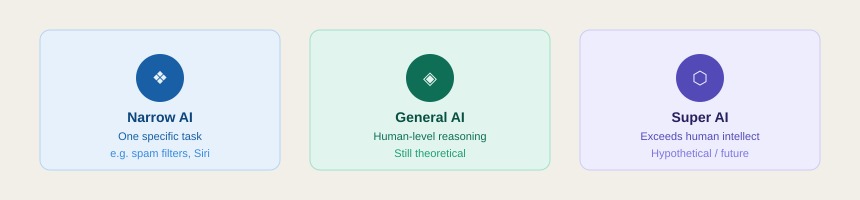
Almost every AI you interact with today is narrow AI — it’s brilliant at one specific task but completely useless outside of it. Spotify’s AI can recommend a perfect playlist, but it can’t help you write a cover letter. ChatGPT can write essays, but it doesn’t have a body that can navigate a room.
General AI — the kind that can think and reason like a human across any domain — is still a goal researchers are working toward. Don’t let Hollywood fool you; we’re not quite there yet.
How Does AI Actually Work? The Core Concepts Explained
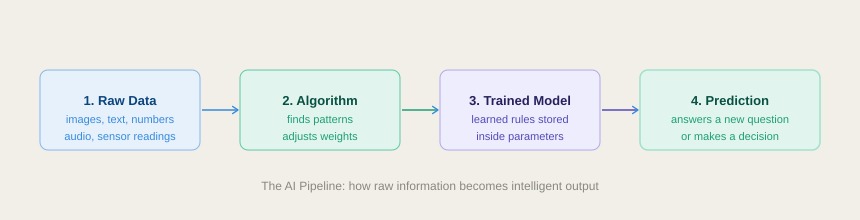
Here’s the big secret about how AI works: it learns from examples. You show an AI system thousands (sometimes billions) of examples, and it finds the patterns connecting inputs to outputs. Over time it gets really, really good at applying those patterns to new situations it has never seen before.
Think of it like teaching a child to recognize a dog. You don’t hand them a 500-page rulebook about fur, four legs, and tails. You just show them a bunch of dogs — and they figure out the pattern themselves. AI does the exact same thing, just with numbers and equations instead of a child’s brain.
Machine Learning: Teaching Computers to Learn

Machine learning is the engine behind most modern AI. Instead of a programmer writing explicit rules (“if the email contains the word ‘free money’, mark it as spam”), a machine learning system studies thousands of spam emails and figures out the rules on its own. That’s why Gmail’s spam filter keeps getting better — it’s learning from every email you mark as spam.
There are three main flavors of machine learning. Supervised learning trains on labeled examples (like tagged photos). Unsupervised learning finds hidden patterns in unlabeled data. And reinforcement learning learns through trial and error, like a video game character figuring out the fastest route through a maze by trying millions of paths and getting rewarded for shorter ones.
Deep Learning and Neural Networks: The Brain Analogy
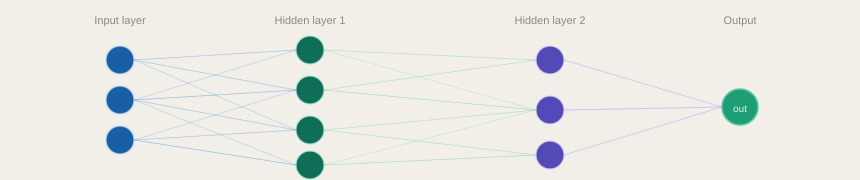
Deep learning is a subset of machine learning inspired loosely by the structure of the human brain. Instead of one layer of pattern detection, deep learning stacks many layers on top of each other — each layer learning increasingly abstract features. The first layer of an image-recognition model might detect edges. The next layer detects shapes. The layer after that detects faces. By the time you’re at layer 50, the model is recognizing “this is a golden retriever.”
These stacked layers are called neural networks, and the “deep” in deep learning just means the network has many layers. Modern AI like GPT-4 or Google’s Gemini uses neural networks with hundreds of billions of parameters — think of parameters as the knobs the AI tunes during training.
Everyday Examples of AI You Already Use
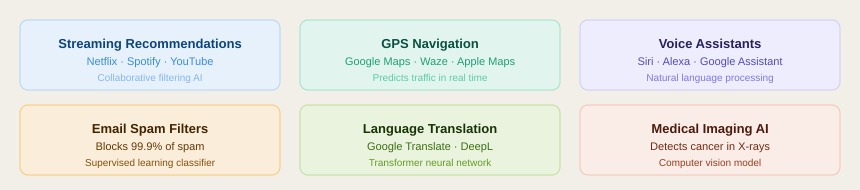
You might not realize it, but you interact with AI dozens of times a day. When Netflix says “because you watched Stranger Things, you might like Severance” — that’s AI. When Google Maps reroutes you around unexpected traffic — that’s AI. When your bank flags an unusual transaction at 3am — definitely AI.
In healthcare, AI models trained on millions of X-rays can now detect early signs of lung cancer with accuracy that rivals experienced radiologists. In finance, fraud detection algorithms analyze hundreds of data points in milliseconds to decide whether to approve or block a transaction. These aren’t future promises — they’re happening right now.
AI in Natural Language Processing (NLP)

Natural Language Processing, or NLP, is the branch of AI that handles human language. Translating Spanish to English, summarizing a 50-page report in 3 sentences, answering customer service questions — all of this runs on NLP. The breakthrough technology powering most modern NLP systems is called the Transformer, invented by Google researchers in 2017. Transformers can process entire sentences at once and understand context and meaning in a way previous AI systems simply couldn’t.
Every time you ask ChatGPT, Claude, or Gemini a question, you’re using a large language model (LLM) — a transformer trained on an enormous amount of text from the internet, books, and other sources. It doesn’t “understand” language the way you do, but it’s incredibly good at predicting what the most helpful, coherent response looks like.
The History of AI: From Science Fiction to Your Smartphone

The story of AI starts in 1950 when mathematician Alan Turing asked: “Can machines think?” He proposed a test — now called the Turing Test — where a human tries to tell the difference between a machine and a person through text conversation. We’ve spent the following 75 years building toward that vision.
The field went through several “winters” — periods when funding dried up because AI couldn’t deliver on its hype. But everything changed around 2012, when a deep learning model called AlexNet crushed the competition in an image-recognition contest, proving that neural networks trained on GPUs were the future. Then in 2017, Google researchers published a paper called “Attention Is All You Need,” introducing the Transformer architecture that now powers virtually every cutting-edge AI system.
Benefits and Risks of Artificial Intelligence
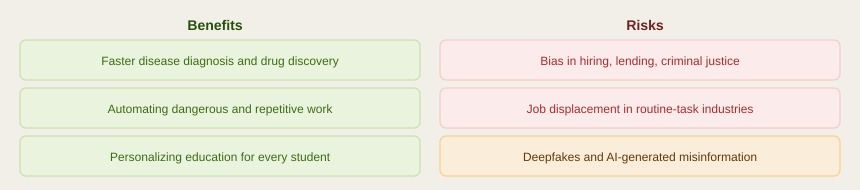
Let’s be real — AI is both incredibly exciting and genuinely concerning, depending on how it’s used. On the positive side, AI is accelerating scientific progress at a pace that would have seemed impossible a decade ago. In 2022, DeepMind’s AlphaFold solved the protein-folding problem that had stumped biologists for 50 years, potentially unlocking cures for diseases we’ve never been able to treat.
But the risks are real too. AI systems trained on biased data can perpetuate and amplify discrimination. Generative AI makes it easier than ever to create convincing fake images, audio, and video. And while AI will certainly create new jobs, it will also automate many existing ones — and the transition won’t be painless for everyone.
Ethical Considerations in AI Development

The AI ethics conversation is no longer just academic — it’s shaping laws and regulations around the world. The EU’s AI Act, which came into force in 2024, is the world’s first comprehensive legal framework for AI, classifying systems by risk level and setting strict requirements for high-risk applications like hiring algorithms and medical devices.
Responsible AI development means thinking about fairness, transparency, privacy, accountability, and safety from day one — not bolting on ethics as an afterthought. The companies getting this right tend to build AI people actually trust.
The Future of AI: What Comes Next?

We’re living through the most exciting period in AI history. The systems being built today are multimodal — they can see images, hear audio, read text, and reason across all of them simultaneously. Agentic AI systems can now take real-world actions: booking appointments, writing and running code, browsing the web, managing files. It’s moving fast.
The honest answer to “what comes next?” is that nobody knows exactly. Researchers debate whether AGI (Artificial General Intelligence) is five years away or fifty. What we do know is that AI will keep getting more capable, more embedded in daily life, and more important to understand — which is exactly why you’re reading this guide.
My advice? Don’t be intimidated. The fundamentals aren’t that complicated once someone explains them clearly. And now that you’ve got the foundation, you’re ready to go deeper into any corner of AI that interests you — whether that’s machine learning, generative AI, robotics, or AI ethics.