“By 2030, most project managers won’t be scheduling tasks by hand — the software will do it for them.” That’s the kind of claim you hear a lot these days, and honestly, it’s not far off. Project management has quietly split into two camps. On one side, you’ve got the tried-and-true methods: Gantt charts, status meetings, spreadsheets, and a project manager holding it all together through experience and instinct. On the other side, AI-powered platforms are stepping in to predict delays, reassign tasks automatically, and flag risks before a human ever notices them.
So which one actually works better? The honest answer is: it depends on your team, your budget, and how complex your projects are. But to make a smart decision, you need to understand exactly how these two approaches differ — not just in theory, but in day-to-day practice. That’s what this guide breaks down.
What Is Traditional Project Management?
Traditional project management relies on established frameworks — Waterfall, Agile, Scrum, PRINCE2 — and human judgment to plan, execute, and monitor work. It’s the model most businesses have used for decades, and it still forms the backbone of how teams operate today.
- Built around structured methodologies like Waterfall and Agile
- Relies on manual scheduling, spreadsheets, and status updates
- Project managers make decisions based on experience and team input
- Progress is tracked through regular check-ins and reporting tools
- Well-suited to industries with strict regulatory or documentation needs
What Is AI-Powered Project Management?
AI project management tools layer machine learning and automation on top of (or in place of) manual processes. Instead of a project manager manually updating a timeline, the software analyzes historical data and live inputs to adjust schedules, predict bottlenecks, and recommend next steps.
- Uses machine learning to forecast timelines and budget overruns
- Automates repetitive tasks like status updates and resource assignment
- Flags risks and dependencies before they become visible problems
- Learns from past projects to improve future planning accuracy
- Often integrates with existing tools like Slack, Jira, or Asana
AI vs. Traditional Project Management: Key Differences
Speed and Efficiency
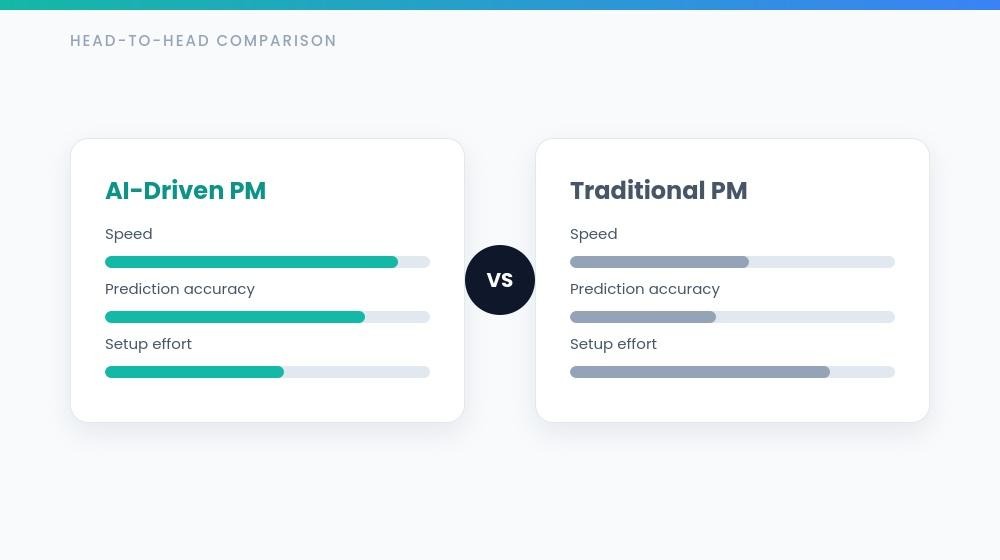
Traditional PM depends on people to notice problems and manually update plans, which takes time. AI-driven systems process changes in real time, so schedules adjust the moment new data comes in. For fast-moving teams, that speed difference is often the biggest selling point of AI tools.
Decision-Making and Risk Prediction
Experienced project managers rely on pattern recognition built from years of managing similar projects. AI does something similar, but at scale — it analyzes thousands of data points across past projects to flag risks a human might miss until it’s too late. Neither approach is perfect; AI can misread context, and humans can be blindsided by bias or fatigue.
Cost and Resource Allocation
Traditional methods allocate resources based on manager judgment and team availability, which works well but can be slow to adapt. AI platforms continuously reallocate resources based on live workload data, which tends to reduce idle time and catch overallocation early.
Team Collaboration and Communication
Traditional project management leans heavily on meetings, status reports, and direct conversations — which builds trust and context, but takes time. AI tools centralize updates and automate reporting, cutting down on meeting overhead, though they can’t fully replace the nuance of a real conversation between teammates.
Benefits of Traditional Project Management
- Human oversight catches nuance and context that data alone can miss
- Easier to explain decisions to stakeholders and clients
- Well-established methodologies with decades of proven results
- No dependency on data quality or software reliability
- Better suited for smaller teams or highly relationship-driven work
Benefits of AI in Project Management
- Reduces manual admin work like status updates and scheduling
- Improves forecasting accuracy using historical project data
- Scales easily across multiple large or complex projects
- Surfaces risks and bottlenecks earlier than manual tracking
- Frees up project managers to focus on strategy and people
Challenges and Limitations of AI in Project Management
AI project management isn’t a silver bullet. It depends on clean, consistent data — feed it messy or incomplete inputs, and its predictions suffer. It can also struggle with the kind of ambiguous, judgment-based decisions that experienced managers handle instinctively, like navigating office politics or reading a client’s unspoken concerns. There’s also a learning curve and upfront cost to implementation, plus the ongoing need for someone on the team who understands how to interpret what the AI is recommending rather than following it blindly.
Which One Should You Choose?
For most teams, the answer isn’t AI or traditional — it’s a hybrid of both. Let AI handle the repetitive, data-heavy work: scheduling, status tracking, and early risk detection. Let human project managers handle the parts that still require judgment: stakeholder relationships, prioritization calls, and navigating unexpected curveballs.
- Small teams or simple projects: traditional methods are often enough
- Large, complex, or multi-project portfolios: AI tools add real value
- Regulated industries: keep human oversight central, use AI to support it
- Fast-scaling teams: AI helps prevent process bottlenecks as headcount grows
Frequently Asked Questions
Is AI project management software expensive?
Costs vary widely. Some platforms offer AI features as an add-on to existing tools like Asana or monday.com, while dedicated AI-native platforms can carry a higher price tag, especially for enterprise plans.
Will AI replace project managers?
Unlikely in the near term. AI is better suited to handling data-heavy tasks, while project managers bring judgment, communication, and stakeholder management skills that current AI tools can’t fully replicate.
Can small businesses benefit from AI project management tools?
Yes, though the return on investment is clearer for teams managing multiple concurrent projects. Smaller teams with simpler workflows may find traditional methods sufficient.
Conclusion
There’s no universal winner in the AI vs. traditional project management debate. Traditional methods offer proven structure and human judgment; AI brings speed, scale, and predictive power. The smartest move for most teams is blending the two — automating the repetitive work so your project managers can spend their time where it actually matters: leading people, not chasing spreadsheets. If you’re evaluating tools, start small, test on one project, and see where AI genuinely lightens the load before rolling it out everywhere.