I’ll never forget the moment I realized I was completely stuck in my career. There I was, three years into a job that paid the bills but left me feeling empty, scrolling through job listings at 2 AM wondering what the heck I was supposed to do with my life. Sound familiar?
Here’s a wild stat that might blow your mind: According to recent workforce studies, over 65% of professionals feel they’re in the wrong career, but they have no clue how to find the right one. That’s where AI career path finder tools come into play, and trust me, they’re absolutely game-changing in 2026!
I spent years trying to figure out my “calling” through personality tests, career counselors, and even that one expensive life coach who told me to “follow my bliss” (thanks for nothing, Karen). But when I finally discovered AI career path finder technology, everything clicked. These tools don’t just throw random job titles at you – they actually analyze your skills, experience, and preferences to map out realistic career options you might never have considered.
The best part? Using an AI career path finder isn’t some complicated tech wizardry anymore. In 2026, these tools have become incredibly user-friendly and accessible to anyone with an internet connection. Whether you’re a recent graduate, someone looking to switch industries, or just curious about what else is out there, AI-powered career guidance can help you make decisions backed by data instead of guesswork.
What Is an AI Career Path Finder and How Does It Actually Work?
So let me break this down in plain English because when I first heard about AI career path finder tools, I thought they were some kind of sci-fi nonsense. Turns out, they’re way more practical than I expected.
An AI career path finder is basically a smart system that uses artificial intelligence and machine learning algorithms to analyze your professional profile and suggest career paths that actually make sense for you. Think of it like having a super-intelligent career counselor who’s studied millions of job transitions and knows exactly which skills translate to which roles. The difference is this counselor never gets tired, never judges you, and works 24/7.
Here’s what really impressed me when I started using these tools: they don’t just look at your job title. A good AI career path finder digs deep into your actual skills, your education, your work history, and even your soft skills to build a complete picture of what you bring to the table. I remember inputting my experience as a marketing coordinator, and the AI picked up on skills I didn’t even realize were valuable – like my ability to analyze data trends and manage cross-functional teams.
The technology behind AI career path finder platforms has gotten ridiculously sophisticated in 2026. These systems use natural language processing to understand job descriptions, predictive analytics to forecast industry trends, and pattern recognition to identify transferable skills. When I first tried one, it analyzed my resume in about 30 seconds and generated a comprehensive skills inventory that would’ve taken me hours to create manually.
What makes an AI career path finder different from traditional career assessments is the personalization. Old-school career tests would ask you questions like “Do you prefer working with people or data?” and then tell you to become a teacher or an accountant. Groundbreaking stuff, right? But AI tools actually look at real-world career transitions from people with similar backgrounds to yours. They show you paths that others have successfully taken, which gives you concrete examples instead of vague suggestions.
The machine learning component is where things get really interesting. As more people use AI career path finder tools and provide feedback on their career moves, the systems get smarter. They learn which transitions work well, which industries are growing, and which skills are becoming more valuable. It’s like having access to the collective wisdom of millions of career changers.
I was skeptical at first – I mean, how could a computer understand my career better than I did? But here’s the thing: an AI career path finder doesn’t replace your judgment. It enhances it. The tool gives you options and insights you might never have discovered on your own, but you’re still the one making the final decision. It’s like having a really smart friend who’s done tons of research to help you out.
Top AI Career Path Finder Tools You Should Try in 2026
Alright, let me share the tools I’ve actually tested because there are a ton of options out there and not all AI career path finder platforms are created equal. Some are genuinely helpful, and others are basically just fancy personality quizzes with an “AI” label slapped on.
The first AI career path finder that really impressed me was LinkedIn Career Explorer. I know, I know – LinkedIn can be overwhelming. But their AI tool has gotten seriously good at analyzing your profile and suggesting career moves based on what people with similar backgrounds have done successfully. What I loved was that it showed me actual people who had made transitions I was considering, so I could see real examples and even reach out to them for advice. The tool uses your connections, skills, and activity to generate personalized recommendations that feel relevant, not random.

Sokanu (now called CareerExplorer) is an AI career path finder that combines traditional career assessment with modern AI technology. What makes it stand out is the depth of career information it provides. After completing their assessment, I got detailed reports on hundreds of potential careers, including day-to-day responsibilities, required education, salary ranges, and personality fit. The AI component continuously refines your matches as you provide feedback, making the recommendations more accurate over time.
For those of you who are already employed and looking to move up or switch roles, Gloat is an AI career path finder that’s often used within companies. Some organizations offer this as an internal tool, and if yours does, definitely take advantage of it. The platform maps your skills to internal opportunities and suggests career paths within your current company. I used a similar internal mobility tool at my last job, and it helped me discover lateral moves I never would have considered.

Jobscan isn’t purely an AI career path finder, but it’s an incredibly useful tool for understanding which of your skills match specific job requirements. You can upload your resume and compare it against job descriptions to see where you’re strong and where you have gaps. The AI analyzes keywords, skills, and experience to give you a match percentage. I used this extensively when I was applying for roles suggested by other AI career path finder tools – it helped me tailor my applications and understand exactly what employers were looking for.

Forage takes a different approach as an AI career path finder by offering virtual work experience programs. The platform uses AI to recommend programs based on your interests and skills, then lets you complete real-world tasks from companies in different industries. This was huge for me because I could actually test out potential career paths before committing to them. The AI tracked which types of tasks I excelled at and enjoyed, then suggested careers that matched those patterns.
Here’s a tool I wish I’d known about earlier: Traitify. This AI career path finder uses visual preference assessments to understand your personality and work style in just a few minutes. Instead of reading through long questions, you look at images and quickly indicate whether they appeal to you. The AI analyzes your choices to identify personality traits, then matches you with suitable careers. It’s fast, intuitive, and the results felt surprisingly on-point.

One more tool worth mentioning: Adzuna’s ValueMyCV. This AI career path finder analyzes your CV and tells you what it’s worth in the current job market. The tool suggests career moves that could increase your earning potential and identifies which skills are most valuable. It’s a bit more focused on salary optimization than some other tools, but if financial growth is a priority for you, the insights are incredibly useful.
The key is to try multiple AI career path finder tools because each one uses different algorithms and focuses on different aspects of career matching. What one tool misses, another might catch. I created a spreadsheet to track recommendations from different platforms, and the careers that appeared across multiple tools became my primary focus areas.
Why Traditional Career Planning Methods Are Falling Short in 2026
Look, I’m not here to completely trash traditional career counseling, but let me tell you about my experience. I paid $200 for a career assessment that consisted of answering 150 multiple-choice questions about whether I liked “working outdoors” or “organizing files.” The result? A printout telling me I should consider careers in “business or education.” Gee, thanks. That really narrows it down.
The problem with old-school career planning is that it’s based on static frameworks that don’t account for how fast the job market is changing. I mean, think about it – half the jobs that are hot right now didn’t even exist ten years ago. Traditional career counselors, no matter how well-meaning, can’t possibly keep up with every emerging field, every new role, and every shifting skill requirement. That’s where an AI career path finder actually shines, because it’s constantly updating its database with current market data.
Here’s something that really frustrated me about conventional approaches: they treated career planning like a one-time event. You take a test, you get your results, and boom – you’re supposed to have your whole future figured out. But careers aren’t linear anymore! People switch industries, learn new skills, and pivot multiple times throughout their working lives. An AI career path finder gets this. It’s designed for the reality of modern work, where flexibility and adaptability matter more than following a predetermined path.
Traditional methods also tend to box you into categories based on your current role or education. When I was trying to transition out of marketing, every counselor I talked to kept steering me toward other marketing positions. “But you have so much experience in marketing,” they’d say. Yeah, and I was miserable! An AI career path finder doesn’t have these biases. It looks at your transferable skills objectively and shows you opportunities across different industries that you might never have considered.
Another huge limitation is access and cost. Quality career counseling is expensive, and not everyone can afford multiple sessions with a professional. Even if you can afford it, scheduling appointments, waiting for feedback, and going through the whole process takes forever. Meanwhile, an AI career path finder gives you instant results, costs a fraction of the price (many are even free), and you can use it as many times as you want without feeling like you’re wasting someone’s time.
The lack of data-driven insights in traditional methods really bothered me too. Career counselors might share anecdotes or general trends, but they can’t give you hard numbers on salary ranges, job growth projections, or skill gaps in specific industries. An AI career path finder pulls from massive datasets to show you exactly what skills are in demand, which roles are growing, and what you might need to learn to make a successful transition. That’s the kind of information that actually helps you make informed decisions.
I also found that traditional career assessments focused way too much on personality traits and not enough on practical skills. Sure, knowing whether you’re an introvert or extrovert might be helpful, but what I really needed to know was: What can I actually do? What skills do I have that employers value? Which of my abilities are transferable to other fields? An AI career path finder answers these questions directly by analyzing your concrete experience and matching it to real job requirements.
The Key Benefits of Using an AI Career Path Finder for Skill-Based Career Matching
Okay, so here’s where things get really exciting. When I finally committed to using an AI career path finder consistently, I started seeing benefits I never expected. Let me walk you through what actually makes these tools so valuable.
First off, the skills-based matching is absolutely revolutionary. Instead of being pigeonholed by your job title, an AI career path finder breaks down everything you know how to do into discrete skills. I discovered I had way more marketable abilities than I realized! The tool identified skills from projects I’d worked on years ago that were suddenly relevant to emerging fields. It’s like having someone mine your entire work history for hidden gems.
The speed and efficiency blew me away too. I remember spending weeks researching different career options, reading job descriptions, trying to figure out what skills were transferable. An AI career path finder did all of that in minutes. It analyzed thousands of job postings, identified patterns, and presented me with a curated list of realistic options. That time savings alone was worth it – I could spend less time researching and more time actually developing new skills or networking.
Here’s something that really helped me: the unbiased recommendations. An AI career path finder doesn’t care about your age, your background, or what your parents think you should do. It just looks at the data. When the tool suggested I consider roles in data analysis, my first reaction was “But I’m not a numbers person!” Turns out, I had been doing data analysis in my marketing job all along – I just never called it that. The AI saw past my self-limiting beliefs and showed me opportunities I was actually qualified for.
The personalization aspect is incredible too. A good AI career path finder learns from your preferences and adjusts its recommendations. If you explore certain types of roles more than others, it picks up on that and refines its suggestions. It’s like the tool gets smarter the more you use it. I started out interested in project management roles, but as I explored options, the AI noticed I was clicking on positions that involved creative problem-solving and started showing me more opportunities in that direction.
One benefit I didn’t anticipate was the confidence boost. Before using an AI career path finder, I felt lost and inadequate. Seeing my skills mapped out clearly, with specific career paths attached to them, made me realize I had more options than I thought. It’s one thing to have vague feelings about your abilities – it’s another to see them validated by data showing exactly where they’re valued in the job market.
The salary insights were eye-opening too. An AI career path finder doesn’t just tell you what jobs you could do – it shows you what those jobs actually pay. I discovered some roles that used my existing skills but paid significantly more than what I was making. Other suggestions were lateral moves that offered better work-life balance or growth potential. Having that financial information upfront helped me prioritize which paths to pursue first.
Another huge advantage is the identification of skill gaps. The AI career path finder I used didn’t just say “Hey, you could be a UX designer!” It showed me exactly which skills I already had, which ones I needed to develop, and even suggested specific courses or certifications to bridge those gaps. That kind of actionable guidance is worth its weight in gold. Instead of feeling overwhelmed by a complete career change, I had a clear roadmap of what to learn next.
The industry trend analysis really helped me make smarter long-term decisions too. An AI career path finder pulls in labor market data to show you which fields are growing, which are declining, and where the opportunities will be in the next 5-10 years. This helped me avoid jumping into a “hot” field that was actually already saturated or heading for automation. Instead, I could focus on sustainable career paths with real future potential.
How to Prepare Your Skills Inventory for an AI Career Path Finder
This part is super important, and I learned it the hard way. The quality of recommendations you get from an AI career path finder depends heavily on the information you feed into it. Garbage in, garbage out, you know?
When I first used an AI career path finder, I rushed through the setup and basically just uploaded my resume without thinking about it. The results were… okay. Generic. Not terrible, but not particularly insightful either. Then I realized I needed to actually prepare my information strategically to get the most out of these tools.
Start by creating a comprehensive skills inventory before you even open an AI career path finder. I’m talking about really digging into everything you know how to do, not just the obvious stuff that’s on your resume. Grab a notebook or open a document and start brain-dumping every skill you’ve used in any job, volunteer work, hobby, or project. Include technical skills like software programs you know, but don’t forget soft skills like communication, problem-solving, and leadership.
Here’s a technique that helped me: go through old performance reviews, project descriptions, and even emails where people thanked you for helping with something. These sources often reveal skills you’ve forgotten about or undervalued. When I did this exercise, I found references to budget management, vendor negotiation, and crisis management – none of which were prominently featured on my resume, but all of which were valuable to employers.
Quantify your skills whenever possible because AI career path finder tools often give more weight to skills with measurable outcomes. Instead of just listing “project management,” I wrote “managed cross-functional teams of 8-12 people on projects with budgets up to $150K.” The specificity helps the AI understand the level and scope of your experience.
Don’t make the mistake I initially made of only listing job-related skills. An AI career path finder can find surprising connections between seemingly unrelated abilities. I used to organize community events as a volunteer, which involved logistics, vendor coordination, and budget tracking. When I added those skills to my profile, the AI suggested event planning and operations roles I hadn’t considered. Your hobbies, side projects, and volunteer work often develop transferable skills that are super relevant to career paths you might not expect.
Break down your skills into categories to make them easier for the AI career path finder to process:
- Technical skills: Software, tools, programming languages, technical methods
- Soft skills: Communication, leadership, teamwork, adaptability, critical thinking
- Industry knowledge: Specific expertise in sectors like healthcare, finance, education, tech
- Functional skills: Marketing, sales, operations, finance, human resources
- Analytical skills: Data analysis, research, problem-solving, strategic thinking
- Creative skills: Design, writing, content creation, innovation
Use industry-standard terminology when describing your skills because AI career path finder algorithms are trained on job postings and professional profiles that use specific keywords. If you’re a “website maker,” call yourself a “web developer” or “front-end engineer.” If you “help customers,” specify whether you do “customer service,” “customer success,” or “technical support.” The right terminology helps the AI match you more accurately to relevant opportunities.
I also recommend updating your LinkedIn profile thoroughly before using AI career path finder tools that integrate with it. Make sure your headline accurately reflects your skills, not just your current job title. Add all relevant skills to your profile, and try to get endorsements for your most important ones. Many AI tools pull data from LinkedIn, so the more complete your profile, the better your recommendations will be.
Be honest about your skill levels too. Most AI career path finder platforms let you indicate whether you’re a beginner, intermediate, or expert in different areas. This matters because the tool uses this information to suggest appropriate career paths. If you overstate your abilities, you might get recommendations for roles you’re not actually qualified for yet. If you understate them, you might miss opportunities where you’d excel.
Create a separate document that lists your accomplishments and impact, not just your responsibilities. AI career path finder tools are getting better at understanding context, and showing what you’ve achieved helps the algorithm assess your potential. Instead of “responsible for social media,” I wrote “grew Instagram following from 2,000 to 25,000 in 18 months and increased engagement rate by 340%.” That kind of detail helps the AI understand you don’t just do social media – you do it effectively.
Creating Your Career Transition Plan Based on AI Insights
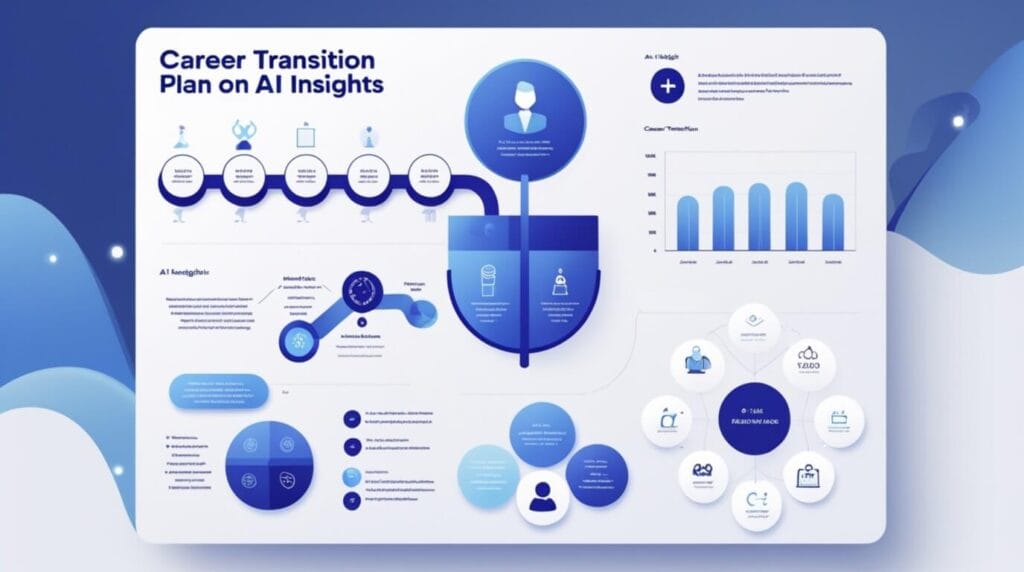
Okay, so you’ve got your results from an AI career path finder. Now what? This is where most people stall out, and honestly, I did too at first. Having information is great, but it’s useless if you don’t do anything with it.
The first thing I did was pick my top three career options from the AI career path finder recommendations. Not ten, not five – three. You need focus or you’ll spread yourself too thin. I chose based on a combination of match percentage, personal interest, salary potential, and how realistic the transition seemed given my current situation. Write these three options down somewhere you’ll see them daily because this is your new focus.
For each of those three career paths, I created what I call a “transition roadmap.” This isn’t complicated – it’s literally just a document outlining the specific steps I needed to take to move from where I was to where I wanted to be. The AI career path finder had already identified my skills gaps, so I knew what I needed to learn. I broke each skill into concrete actions with deadlines.
Let me give you an example from my own experience. One of my top recommendations was transitioning into data analytics. The AI career path finder showed I already had skills in Excel, basic SQL, and data visualization, but I needed to learn Python, improve my statistical analysis, and understand machine learning basics.
My roadmap looked something like this:
- Month 1-2: Complete Python for Data Analysis course on Coursera
- Month 3: Build 3 personal data analysis projects for portfolio
- Month 4: Take statistics refresher course
- Month 5: Learn Tableau or Power BI for advanced visualization
- Month 6: Start applying for junior analyst roles
See how specific that is? The AI career path finder gave me the destination, but I had to map out the journey myself. Breaking it down into monthly goals made it feel achievable instead of overwhelming.
Leverage your existing network to validate the AI career path finder recommendations. I reached out to people in my LinkedIn connections who worked in the careers I was considering and asked if I could do informational interviews. These conversations were invaluable – they helped me understand whether the career paths suggested by the AI actually aligned with my daily life preferences and long-term goals.
Start building the missing skills immediately, even while you’re still in your current job. The AI career path finder might have shown you need certain technical skills or certifications. Don’t wait until you’re “ready” to start learning. I spent an hour each morning before work on online courses, and gradually, those skills started appearing on my resume. By the time I was ready to apply for new roles, I already had 6-8 months of learning under my belt.
Update your resume and LinkedIn profile to emphasize the skills highlighted by the AI career path finder as relevant to your target careers. I completely restructured my resume to lead with transferable skills rather than chronological job history. This made it much easier for recruiters and hiring managers to see how my background connected to the roles I was pursuing.
Create a portfolio or evidence of your capabilities in your target field. The AI career path finder might say you can do something, but employers want proof. I started taking on small freelance projects, contributing to open-source work, and documenting personal projects that demonstrated my growing skills. Having tangible work samples made my transition so much smoother.
Set up job alerts for the specific titles and keywords suggested by your AI career path finder. I used Google Jobs, LinkedIn, Indeed, and specialized industry job boards. Every week, I’d review new postings even if I wasn’t ready to apply yet. This helped me understand what employers were really looking for and allowed me to tailor my learning to match actual job requirements.
Join professional communities related to your target career paths. The AI career path finder got me in the ballpark, but connecting with real people in those fields helped me understand the culture, challenges, and opportunities. I joined Slack groups, attended virtual meetups, and participated in industry forums. These connections led to informational interviews, mentorship opportunities, and eventually job referrals.
Track your progress religiously. I created a simple spreadsheet where I logged every skill I learned, every course I completed, every project I finished, and every networking connection I made. Seeing this progress accumulate over time kept me motivated during the inevitable moments when the transition felt too hard or too slow.
Be prepared to iterate based on real-world feedback. Sometimes an AI career path finder suggestion looks great on paper but doesn’t feel right once you start exploring it. That’s okay! I initially pursued product management based on my results, but after several informational interviews and taking an intro course, I realized it wasn’t actually aligned with my working style. I shifted focus to my second choice without viewing it as failure – it was just gathering more data to refine my path.
Consider getting a coach or mentor who specializes in career transitions. While the AI career path finder provided the strategic direction, having a human guide helped me navigate the emotional and practical challenges of making a change. They helped me prepare for interviews, negotiate offers, and manage the psychological aspects of stepping into a new field.
Don’t quit your current job prematurely. I know it’s tempting when you’re excited about a new direction suggested by your AI career path finder, but most career transitions take 6-18 months of preparation. Use your current role as a base of stability while you build skills, network, and position yourself for the transition. I actually found ways to develop relevant skills within my existing job by volunteering for projects that aligned with my target career.
Combining AI Career Path Finder Results with Human Career Coaching
Here’s something I learned the hard way: AI career path finder tools are incredibly powerful, but they work best when combined with human guidance. I spent six months trying to navigate my career transition using only AI tools, and while I made progress, I was missing crucial context and support.
The AI career path finder gave me the “what” – what careers I could pursue, what skills I needed, what the market looked like. But human coaches and mentors provided the “how” – how to actually position myself for these roles, how to tell my story in a compelling way, how to navigate the emotional ups and downs of career change.
I started working with a career coach about four months into my transition, and the combination of AI insights and human guidance was game-changing. My coach helped me interpret the AI career path finder results through the lens of my personal values and life circumstances. For example, the AI suggested several high-paying career paths that would have required relocation or extensive travel. My coach helped me evaluate whether those tradeoffs aligned with my family situation and lifestyle preferences.
Human coaches also catch things that AI career path finder tools miss. They notice patterns in how you talk about your work, they pick up on your energy levels when discussing different options, and they can challenge limiting beliefs that might be holding you back. My coach pointed out that I kept dismissing leadership roles even though the AI consistently recommended them. Through our conversations, I realized I had imposter syndrome around leadership – not an actual lack of capability.
One of the best ways to combine AI and human guidance is to bring your AI career path finder results to informational interviews with people in your target fields. I’d show them my top recommendations and ask, “Based on your experience in this industry, do you think these suggestions make sense for someone with my background?” These conversations often revealed nuances that no AI could capture – like the fact that certain roles require political savvy more than technical skills, or that specific industries have unwritten rules about career progression.
Networking groups and professional associations complement AI career path finder insights beautifully. The AI might tell you that business analysis is a good fit, but joining a business analysis professional group helps you understand the real day-to-day challenges, the best certifications to pursue, and which companies are actually hiring. Human connections turn abstract recommendations into concrete opportunities.
I also found it helpful to join or create a small accountability group of people also using AI career path finder tools for career transitions. We’d meet monthly to share our progress, troubleshoot challenges, and provide moral support. The AI gave us direction, but the human connection kept us motivated and provided perspective when things got tough.
Consider working with a resume writer or career coach who understands AI applicant tracking systems. Here’s the thing – you’re using an AI career path finder to identify opportunities, but most companies use AI to screen applicants. A human expert can help you optimize your resume to pass both human and AI screening. They understand how to position your skills using keywords that both AI systems and human recruiters will recognize.
Therapists or counselors can play a role too, especially if you’re experiencing anxiety or uncertainty about career change. An AI career path finder provides rational, data-driven guidance, but career transitions are emotional. Having professional support to process feelings of fear, inadequacy, or overwhelm made my transition much smoother. Some of my biggest breakthroughs came from therapy sessions, not AI tools.
Mentors in your target field are invaluable for validating AI career path finder recommendations. I reached out to senior professionals in roles the AI suggested and asked for their honest assessment of my transition plan. They provided reality checks – pointing out which skills truly mattered versus which were just “nice to haves” in job descriptions. They also shared insider knowledge about career trajectories that no AI database contained.
Join masterminds or peer coaching groups where you can get feedback on your career decisions. I participated in a virtual career transition mastermind where members would present their AI career path finder results and get input from the group. Different perspectives helped me see blind spots in my thinking and consider angles I’d missed.
Don’t underestimate the value of hiring managers and recruiters as informal coaches. When I didn’t get jobs I interviewed for, I’d politely ask for feedback. These conversations helped me understand how my AI-suggested career transition was being perceived by actual decision-makers. I learned which aspects of my background to emphasize and which gaps were deal-breakers versus learnable on the job.
The key is using AI career path finder tools as your research and strategy layer, then layering human guidance on top for interpretation, emotional support, and tactical execution. The AI helps you work smarter by processing massive amounts of career data. Humans help you work wiser by adding context, nuance, and accountability that no algorithm can provide.
What’s Coming in 2026 and Beyond
Okay, so here’s where things get really exciting. The AI career path finder tools we have now are impressive, but what’s coming in the next few years is going to blow your mind. I’ve been following the development roadmap for several platforms, and the innovations are wild.
One major advancement I’m seeing is the integration of AI career path finder tools with continuous learning platforms. Instead of just telling you what skills you need, these tools will automatically curate personalized learning paths and track your progress in real-time. Imagine an AI career path finder that says “You need Python skills” and immediately enrolls you in the perfect course, monitors your completion, updates your skill profile automatically, and adjusts career recommendations as you learn. Some platforms are already beta-testing this functionality.
The predictive capabilities are getting scary good too. Next-generation AI career path finder platforms are using machine learning to forecast which careers will be most in-demand 5-10 years from now based on technological trends, demographic shifts, and economic patterns. Instead of suggesting careers that are hot right now, they’ll recommend paths that will have strong opportunities when you’re actually ready to make your move. This forward-looking perspective helps you avoid investing time in fields that might be oversaturated or automated by the time you’re qualified.
Real-time labor market integration is another game-changer. Current AI career path finder tools use labor market data, but it’s often 6-12 months old. The new systems I’m hearing about will pull real-time data from job postings, salary databases, and hiring trends to give you up-to-the-minute insights. You’ll be able to see which companies are actively hiring for your target roles, what skills they’re emphasizing this month, and how competitive the market is right now.
Virtual reality career exploration is coming to AI career path finder platforms, which sounds like science fiction but it’s actually happening. Some companies are developing VR simulations that let you experience a day in the life of different careers suggested by the AI. Want to know what it’s really like to be a data analyst? Put on a headset and spend a virtual day analyzing datasets, attending meetings, and presenting findings. This experiential component will help people make much more informed decisions about career transitions.
The personalization algorithms are becoming incredibly sophisticated. Future AI career path finder tools will consider not just your skills and experience, but your personality traits, work style preferences, values, and even your learning style. They’ll factor in your financial situation, geographic constraints, and family responsibilities. The recommendations will be truly holistic, not just skills-based.
I’m excited about the development of AI career path finder tools that can simulate your earning potential over time for different career paths. They’ll model out scenarios like “If you pursue career A, here’s your likely salary progression over 20 years” versus “If you pursue career B with this additional certification, here’s the financial trajectory.” Having that long-term financial modeling helps you make decisions that optimize for both near-term income needs and long-term wealth building.
Peer matching is another feature coming to AI career path finder platforms. The AI will connect you with people who have similar backgrounds and successfully made the career transition you’re considering. It’s like having automatic access to mentors who’ve walked your exact path. Some systems are even building AI-powered community features where you can ask questions and get advice from both the AI and humans who’ve been through similar transitions.
Natural language processing is advancing to the point where you’ll be able to have actual conversations with your AI career path finder. Instead of filling out forms, you’ll describe your situation in plain language, ask follow-up questions, and get nuanced responses. It’ll feel more like talking to a career counselor than using software. I’ve tested early versions of this, and the conversational interface makes the whole process feel much more natural and accessible.
The integration with applicant tracking systems is going to be huge too. Future AI career path finder tools will not only suggest careers but also optimize your resume and application materials in real-time for specific jobs. The AI will analyze job descriptions, identify key requirements, and automatically format your experience to maximize your match with each position. It’s like having a personal resume writer who customizes your application for every job in seconds.
Skill verification through actual demonstrations is another innovation coming soon. Instead of just listing skills on your profile, you’ll complete micro-assessments or portfolio projects that the AI career path finder uses to verify your capabilities. This addresses one of the current weaknesses – people sometimes overstate or understate their abilities. With objective skill verification, the career recommendations become even more accurate.
I’m also seeing development of AI career path finder tools that integrate mental health and wellbeing assessments. Career decisions aren’t just about skills and money – they’re about finding work that supports your mental health and life satisfaction. Next-gen tools will factor in burnout risk, stress tolerance, and wellbeing indicators when suggesting career paths. They’ll help you find careers that not only pay well but also align with your need for work-life balance.
The ethical AI movement is improving too. Future AI career path finder platforms are being designed with bias detection and fairness algorithms to ensure recommendations aren’t inadvertently discriminatory based on age, gender, ethnicity, or other protected characteristics. They’ll actively work to surface opportunities that might be overlooked due to historical biases in hiring data.
Your Career Journey Starts with One AI-Powered Step
Look, I get it. Career transitions are scary. They’re uncertain. They require you to step outside your comfort zone and potentially risk the stability you’ve built. I’ve been there, and some days I was absolutely terrified I was making a huge mistake.
But here’s what I learned: staying in a career that doesn’t fit is way scarier than taking intentional steps toward something better. And you don’t have to figure it all out on your own anymore. AI career path finder tools have democratized access to career guidance that used to cost thousands of dollars and take months to obtain.
The beauty of using an AI career path finder is that it’s low-risk exploration. You’re not committing to anything by using these tools – you’re just gathering information and understanding your options. Maybe you’ll discover career paths you’re excited about. Maybe you’ll realize you’re actually in the right place and just need to adjust your role slightly. Either way, you’ll have more clarity than you do right now.
Start small if you need to. Pick one AI career path finder tool and spend an hour creating a thorough profile. See what recommendations you get. Research the careers that intrigue you. Have a few informational interviews. Take one online course in a skill area that seems interesting. These small steps compound over time.
Remember that career paths aren’t linear anymore, and that’s actually a good thing. The AI career path finder tools reflect this new reality – they show you multiple possibilities, lateral moves, and unconventional transitions that make sense based on your unique combination of skills. Your career doesn’t have to follow a predetermined trajectory. You get to design it.